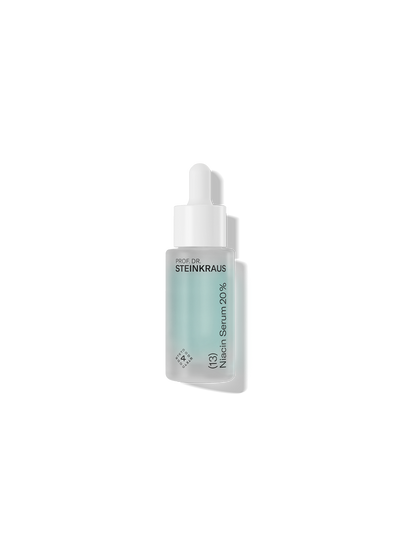
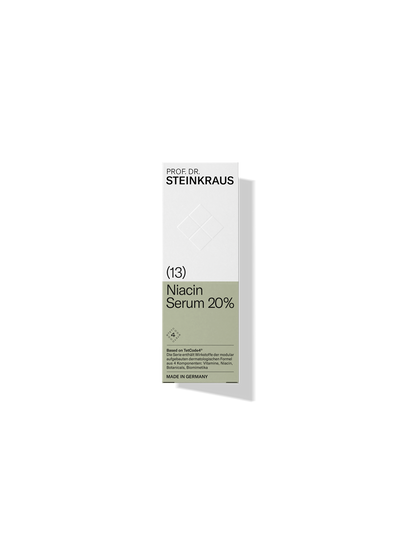
Added to cart
−
+

Niacinamide is neither fast-acting nor purely long-term. It regulates, balances, stabilises – and impresses with an unusually broad range of effects and four well-documented actions, for nearly all skin types.
Niacinamide is vitamin B3 – water-soluble and exceptionally well tolerated. It acts on multiple aspects of skin physiology simultaneously, and does so with well-documented effects.
Here are four of its most important effects:
Niacinamide promotes the formation of ceramides – lipids responsible for holding skin cells together in the stratum corneum. More ceramides mean a denser barrier, less transepidermal water loss, and more resilient skin. The effect is well documented – and those who use niacinamide regularly strengthen the skin’s fundamental structure.
Niacinamide regulates sebum production. In practical terms: less excess sebum, a finer skin texture, the appearance of smaller pores. It also has anti-inflammatory effects, which is why it is frequently used for sensitive skin and rosacea.
The mechanism here is particularly interesting. Pigmentation irregularities do not arise because too much melanin is produced, but because it is transported unevenly into the upper skin layers. Niacinamide inhibits precisely this transport – by blocking the transfer of melanosomes to keratinocytes. The result is a more even complexion, fewer age spots, a calmer pigment distribution – all without suppressing melanin production itself.
Niacinamide supports the skin’s central protective mechanisms. It acts as an antioxidant, neutralises free radicals, and helps make the skin more resistant to external stressors. In short: niacinamide strengthens the skin’s immune system – and helps keep it healthy.
Within the system of actives, niacinamide has its own place. Hyaluronic acid is the sprinter: fast, immediately visible, but temporary. Vitamin A and vitamin C are the long-distance runners: they change the skin’s structure, but take months to show results. In this sense, niacinamide is the middle-distance runner: the first results appear after weeks, not hours – but not after six months either. Niacinamide regulates, balances, stabilises – and combines with almost all other actives. Which makes it a central building block in any thoughtful skincare routine.